Tuesday, February 25, 2020

fixing medical in the us.

Doctoring is way too expensive in this country because of insurance.   The doctors have an incentive to over provide and over charge and use you, the patient as leverage, and the insurance companies have an incentive to squash that, even when your doctor isn't doing that.  

Let's say that you have a small practice with 3 doctors in a retail space.  The space costs about 15,000 a month to pay for rent utilities, equipment maintenance and replacement. the doctors get 15000 a month and a receptionist gets 5000 a month.  That's 35,000 a month or 1600 a day (assuming 5 day workweek). and they see on average 2 patients an hour for 6 hours, and spend a couple hours a day keeping current and running the business stuff.   So that's 36 patients a day.   That's $50 a visit plus maybe $10 in supplies.  If you go to the doctor every month that would only be $60 a month.  Like a cell phone bill.  That's affordable, good care.  With insurance that bill is 5 times that.   Get rid of insurance at the primary care level and there are huge gains in medical quality.   

So the first step is to get insurance completely out of primary care, and give people who are in poverty doctor stamps.  (I would actually do this with an HSA, and open up the law so that everyone had an HSA, not just those with certain high deductible insurance plans.)

Emergency care is another animal.  I go with the school model here.  Free public hospitals and allow the existence of private hospitals running on insurance.  With the caveat that no employer can provide insurance.  Private hospitals would be the rare exception.  Having a market is essential as a barometer for the public hospitals so that the care doesn't fall too far behind the rich, and as an avenue for the rich to fund innovation that will bleed down to the public hospitals.   

Drugs are easy.   Government grants and xprizes pay for r&d and there are no patents .   Trust bust the major manufacturers so that there are a good healthy 10 to 20 major competitors.  

Then I know I'm missing some long term care stuff for disability, rehab, therapy, etc.   That's much more tricky and I'm not as knowledgeable.  It would help if all of that treatment was tax free.   I'm not sure if that is enough.  I'm open to suggestion here.  

Monday, January 13, 2020

Hayek and the UBI

Note: This is part of the “Promise of Republicanism” series, which can be found here in its entirety.
The idea of a Universal Basic Income (UBI) is getting a lot of attention these days, thanks largely to the fact that Democratic presidential candidate Andrew Yang has made it the centerpiece of his campaign. Yang calls his version of the UBI the “Freedom Dividend,” a proposal under which every American over the age of eighteen would receive $1,000 a month from the Federal government, no strings attached.
The name “Freedom Dividend” is, of course, a nice bit of political rhetoric for an electorate largely inclined to view any large-scale scheme of income redistribution as a form of socialism. But beneath the rhetoric lies a legitimate, substantive point. Yang is right: There’s a good case to be made for a UBI based on the importance of individual freedom. Indeed, the foundations of that case have already been laid by none other than the renowned champion of economic and personal liberty, Friedrich Hayek.
Hayek’s devotion to the ideals of free markets and limited government is well-known. His most famous book, The Road to Serfdom, argued that economic and political liberties are tightly connected, and that liberal democracies cannot safely curtail the former without also endangering the latter. His later works, especially The Constitution of Liberty, set forth a positive vision of a free society centered on the idea that individuals should be left largely free to act on the basis of their own values and beliefs, rather than those of government regulators or planners, in both the personal and economic dimensions of their lives.
While everybody knows that Hayek saw himself as a champion of individual freedom, few understand the precise nature of the freedom that Hayek sought to defend. Unlike many libertarians, who understand freedom primarily in terms of non-interference or respect for property rights, Hayek subscribed to a republican theory in which freedom consists of being able to live one’s life “according to [one’s] own decisions and plans, in contrast to … one who was irrevocably subject to the will of another.”
Understanding Hayek as a “commercial republican” helps to make sense of many different aspects of his political theory. It explains why, unlike many libertarians, Hayek was never seriously tempted by the idea of “anarcho-capitalism.” Hayek did not believe that government was necessarily inimical to freedom. Indeed, he believed that government, or at least governance, in the sense of a set of institutions that subject human conduct to general and impartial rules, is a necessary precondition for freedom. For example, traffic laws limit the actions we can perform, but they do so in a way that makes us more free rather than less. They do so by allowing us to form reliable expectations about the behavior of others, which enables us to carry out our own plans more effectively than we could without them. However, a tyrant who can order us to perform or refrain from specific behaviors at a whim deprives us of the ability to effectively set and pursue our plans with any confidence — even if the tyrant happens not to interfere at any given time. The fact that it is always in her power to intervene in any way she likes strips us of control over our lives, and thus renders us unfree. 
Considerations such as these explain why Hayek continually emphasized the distinction between general rules on the one hand and commands on the other (or between law and legislation) in his writings. To be subject to the commands of a tyrant is to be dependent on the arbitrary will of another person. The actions of those subject to commands are based not on the beliefs and values of the actor, but on the beliefs and values of the tyrant. In contrast, general and impersonal rules do not subject individuals to the will of anyone else. They are, in Hayek’s words, like “laws of nature” – stable facts of social existence around which individuals can learn to navigate and plan their lives. They do not place some citizens in a position of subordination, nor do they elevate others to a position of dominance.

Free Markets and Limited Government

Hayek’s republican political theory provides one of the main theoretical foundations for his strong support of free markets. Although many contemporary republican theorists have been either overtly hostile or at best lukewarm toward the market economy, Hayek saw correctly that market competition can serve as one of the most effective guarantors of republican freedom.
The essence of market competition is the existence of alternatives, and the right to say “no” to offers that fail to serve one’s interests at least as well as one of those alternatives. In a competitive labor market, an employer who tries to force an employee to do something she doesn’t want to do is constrained by that employee’s ability to quit and find a job elsewhere. A used car dealer who would like to take advantage of a buyer by charging an unfairly high price is similarly constrained by the presence of a competing dealer next door. In general, the more competitive a market is, the more prices and other terms of agreements will be regulated by the impersonal forces of supply and demand, and the less any particular market agent will be able to impose her particular will on her partner in exchange. All market actors are constrained by the general, impersonal rules of the market. But those same rules generally work to prevent any market actors from achieving a position of dominance over others.
Similarly, it is largely because Hayek views competition as such an effective check on coercion that he views government power with suspicion. After all, government is the only institution within society to claim and generally possess an effective monopoly on the use of force. And this monopoly on force is often used to establish and maintain other monopolies: on roads, on the delivery of regular mail, on the creation and enforcement of criminal law, and so on. Because individuals who value these services have nowhere else to go, they are often left with no practical alternative to compliance with the government’s demands. 
Moreover, as legal rules become more numerous and complex, as ordinary individuals become unable to know in advance what actions are permitted and which are prohibited, as law enforcement becomes practically unable to enforce all the rules that they could, in theory, enforce, the extent of individual discretion within government increases, and so too does the possibility of arbitrary coercion. In that case, individuals are no longer required to comply with “the law,” but with the edicts of a bureaucrat behind a desk, or an officer behind a badge. When the agents of the state are granted a practically unchecked power to apply the law (or not) in whatever way he sees fit, individuals are no longer fully free.

When Free Markets Aren’t Enough

But while Hayek’s republicanism provides strong support for the ideals of free markets and limited government, it also provides a criterion for determining when those institutions are not enough. Market competition generally protects the consumer against predation by unscrupulous sellers, but this protection can be undermined by collusion and natural monopolies. Similarly, competition in the labor market might protect workers from exploitation when those workers have an adequate range of alternatives available to them, but fall short when those alternatives are limited either by features of the local economy (a lack of jobs) or by characteristics of the employee (e.g. limited skills or lack of mobility).
In order to protect individual freedom in these circumstances, Hayek believed that some governmental action was both necessary and appropriate. Indeed, Hayek took great pains even in his most partisan work, The Road to Serfdom, to distance himself from a dogmatic opposition to government action, writing that “nothing has done so much harm to the liberal cause as the wooden insistence of some liberals on certain rough rules of thumb, above all the principle of laissez faire.” Hayek believed that government had a legitimate (though delicate) role to fill in preventing and/or regulating monopolies. He believed that government had important work to do in the areas of sanitation, health services, and public works. And, most strikingly of all, he believed that it was not only permissible but necessary for government to redistribute income in order to provide a social safety net that would ensure “a certain minimum income for everyone, or a certain floor below which nobody need fall even when he is unable to provide for himself.”

A Guaranteed Minimum Income For All?

Hayek himself did not have much to say about why he thought such a policy might be justified. But Hayek’s commitment to republican freedom provides a starting point from which an argument can easily be constructed. Poverty, while not itself coercive, renders people vulnerable to coercion by others. A wife who is dependent on her husband’s paycheck may have to put up with abusive behavior simply in order to keep a roof over her head. And as Hayek himself noted, an employee in a slack labor market must do what his boss tells him or else risk destitution. In these cases and many more, people are unable to escape serious and pervasive interference by others because they lack the financial resources to stand on their own. Providing people  with money gives them options, and thus the ability to live their lives in accordance with their own will, rather than in subjugation to the will of another.
Moreover, there are strong Hayekian reasons for providing assistance in the form of cash, rather than in-kind benefits. One of the most powerful and consistent themes in all of Hayek’s work is the idea that government planners often lack “knowledge of the particular circumstances of time and place” that would be necessary to carry out their plans effectively. For Hayek, that limitation was an important part of the case for decentralized (i.e., free market) economic planning. But these same considerations provide a powerful argument for redistribution taking the form of cash grants, as opposed to in-kind transfers. Cash gives individuals the freedom to decide for themselves what they need, whether that is paying rent, buying groceries, or saving for future consumption. A system of in-kind transfers, in contrast, puts those decisions in the hands of government, where they are at least as likely to be determined by powerful special interests as they are by genuine and accurate considerations of recipients’ basic needs. 
Hayek’s support of a minimum income is compatible with his famous rejection of “social justice.” There is a difference, Hayek argued, between a society that “accepts the duty of preventing destitution and of providing a minimum level of welfare” and one which seeks to “determine the ‘just’ position of everybody and allocates to each what it thinks he deserves.” The latter task requires a level of knowledge on the part of government that Hayek believed was impossible to obtain, and a level of discriminatory power that he believed was incompatible with a free society. The former, in contrast, could be administered by precisely the sort of general, impartial rules that Hayek believed were essential to a genuinely liberal order.

Stopping Short of a UBI

Still, despite all this, it would be misleading to claim that Hayek supported a Universal Basic Income. One of the defining features of a UBI is the idea of unconditionality, meaning that eligibility is not limited to those who are working, or who are willing to work. And this is an idea that Hayek explicitly and repeatedly rejected.
I do not question any individual’s right voluntarily to withdraw from civilisation. But what  “entitlements” do such persons have? Are we to subsidise their hermitages? There cannot be any entitlement to be exempted from the rules on which civilisation rests. We may be able to assist the weak and disabled, the very young and old, but only if the sane and adult submit to the impersonal discipline which gives us means to do so.
Still, just because Hayek rejected a UBI does not mean that Hayekians must do so. Indeed, as I argue in more detail elsewhere, Hayek’s own fundamental principles provide one of the best arguments for rejecting the kind of “work requirement” that Hayek himself endorses. In particular, Hayek’s own insights into the radically dispersed nature of “knowledge of the particular circumstances of time and place” pose a serious obstacle to conditional schemes such as those he favored.
The problem is this: Hayek’s support of a work requirement appears to be based on a kind of reciprocity principle according to which those who seek to benefit from the productive activities of society have a moral obligation to make some reciprocal contribution to society. But it would clearly be a mistake to assume that paid labor is the only way to make such a contribution. Artists, parents, and caregivers, for instance, all make (or are capable of making) an important contribution to society, even if none of them are engaged in the sort of “work” that would qualify them for benefits under something like the Earned Income Tax Credit.
Furthermore, even if the reciprocity principle is true, presumably some accommodation will have to be made for those who are genuinely incapable of making a reciprocal contribution. Those who are physically or mentally unable to work, for instance, presumably should not be excluded from receiving benefits even if one thinks that those who are able but unwilling to work should not be eligible.
So, in order to correctly apply Hayek’s principle, governments would have to know both (a) what sorts of activity count as a legitimate reciprocal contribution and which do not, and (b) which particular individuals are genuinely incapable (as opposed to just unwilling) to make such a contribution. But how could we expect governments to accurately arrive at this information? What standard should they apply to distinguish between legitimate and illegitimate contributions to social welfare? What sort of intrusive powers will they require to distinguish between a genuine inability to find work and mere shiftlessness? The Hayekian case for an unconditional benefit is that it economizes on government’s scarce knowledge, and that it errs on the side of protecting individuals who truly are in danger of subjugation due to their economic vulnerability, even if that means erring on the side of supporting some individuals who do not truly need it.

Principle and Policy

Hayek’s republicanism provides an attractive way for reconciling a commitment to free markets and limited government with support for a social safety net. Moreover, Hayek’s particular emphasis on the significance of dispersed knowledge push in favor of that safety net taking the form of a UBI.
This principled case for a UBI leaves many concerns of a more practical nature unanswered. Wouldn’t the UBI cost too much? Wouldn’t it discourage work? Wouldn’t it turn the United States into a welfare magnet or, on the flip side, lead voters to push for even tighter restrictions on immigration?
But these concerns are not really objections to a UBI as such. Rather, they are objections to particular ways in which a UBI might – or might not – be set up. It is probably best to think of the UBI not as a single policy but as a family of policies, all of which involve cash transfers, but which vary according to the size of those transfers, whether or not they are means-tested, what sort of citizenship and residency requirement are attached to them, and so on. 
My own inclination is to favor a UBI in the form of a Negative Income Tax (as Niskanen’s Samuel Hammond has argued, UBI is really just a NIT with a leaky bucket), and to address concerns about excessive costs and unemployment effects by altering the size and phase-out rate of the transfer. But as Miranda Fleischer and Daniel Hemel have pointed out, there are a variety of different ways of structuring the “Architecture of a Basic Income,” each with its own costs and benefits. 
The important point is that pragmatic concerns about the UBI can largely if not entirely be addressed at the level of policy design. If the Hayekian argument I have presented here is correct, and there really is a good case to be made for a UBI on grounds of a republican conception of individual freedom, then we should not let such concerns stand in the way of making progress toward a basic income for all.

Tuesday, December 17, 2019

Why working class people vote conservative


https://www.theguardian.com/society/2012/jun/05/why-working-class-people-vote-conservative

we have identified six moral concerns as the best candidates for being the innate "taste buds" of the moral sense: care/harm, fairness/cheating, liberty/oppression, loyalty/betrayal, authority/subversion, and sanctity/degradation. Across many kinds of surveys, in the UK as well as in the USA, we find that people who self-identify as being on the left score higher on questions about care/harm. For example, how much would someone have to pay you to kick a dog in the head? Nobody wants to do this, but liberals say they would require more money than conservatives to cause harm to an innocent creature.
But on matters relating to group loyalty, respect for authority and sanctity (treating things as sacred and untouchable, not only in the context of religion), it sometimes seems that liberals lack the moral taste buds, or at least, their moral "cuisine" makes less use of them. For example, according to our data, if you want to hire someone to criticise your nation on a radio show in another nation (loyalty), give the finger to his boss (authority), or sign a piece of paper stating one's willingness to sell his soul (sanctity), you can save a lot of money by posting a sign: "Conservatives need not apply."

Why on Earth would a working-class person ever vote for a conservative candidate? This question has obsessed the American left since Ronald Reagan first captured the votes of so many union members, farmers, urban Catholics and other relatively powerless people – the so-called "Reagan Democrats". Isn't the Republican party the party of big business? Don't the Democrats stand up for the little guy, and try to redistribute the wealth downwards?
Many commentators on the left have embraced some version of the duping hypothesis: the Republican party dupes people into voting against their economic interests by triggering outrage on cultural issues. "Vote for us and we'll protect the American flag!" say the Republicans. "We'll make English the official language of the United States! And most importantly, we'll prevent gay people from threatening your marriage when they … marry! Along the way we'll cut taxes on the rich, cut benefits for the poor, and allow industries to dump their waste into your drinking water, but never mind that. Only we can protect you from gay, Spanish-speaking flag-burners!"
One of the most robust findings in social psychology is that people find ways to believe whatever they want to believe. And the left really want to believe the duping hypothesis. It absolves them from blame and protects them from the need to look in the mirror or figure out what they stand for in the 21st century.
Here's a more painful but ultimately constructive diagnosis, from the point of view of moral psychology: politics at the national level is more like religion than it is like shopping. It's more about a moral vision that unifies a nation and calls it to greatness than it is about self-interest or specific policies. In most countries, the right tends to see that more clearly than the left. In America the Republicans did the hard work of drafting their moral vision in the 1970s, and Ronald Reagan was their eloquent spokesman. Patriotism, social order, strong families, personal responsibility (not government safety nets) and free enterprise. Those are values, not government programmes.


The Democrats, in contrast, have tried to win voters' hearts by promising to protect or expand programmes for elderly people, young people, students, poor people and the middle class. Vote for us and we'll use government to take care of everyone! But most Americans don't want to live in a nation based primarily on caring. That's what families are for.
One reason the left has such difficulty forging a lasting connection with voters is that the right has a built-in advantage – conservatives have a broader moral palate than the liberals (as we call leftists in the US). Think about it this way: our tongues have taste buds that are responsive to five classes of chemicals, which we perceive as sweet, sour, salty, bitter, and savoury. Sweetness is generally the most appealing of the five tastes, but when it comes to a serious meal, most people want more than that.
In the same way, you can think of the moral mind as being like a tongue that is sensitive to a variety of moral flavours. In my research with colleagues at YourMorals.org, we have identified six moral concerns as the best candidates for being the innate "taste buds" of the moral sense: care/harm, fairness/cheating, liberty/oppression, loyalty/betrayal, authority/subversion, and sanctity/degradation. Across many kinds of surveys, in the UK as well as in the USA, we find that people who self-identify as being on the left score higher on questions about care/harm. For example, how much would someone have to pay you to kick a dog in the head? Nobody wants to do this, but liberals say they would require more money than conservatives to cause harm to an innocent creature.
But on matters relating to group loyalty, respect for authority and sanctity (treating things as sacred and untouchable, not only in the context of religion), it sometimes seems that liberals lack the moral taste buds, or at least, their moral "cuisine" makes less use of them. For example, according to our data, if you want to hire someone to criticise your nation on a radio show in another nation (loyalty), give the finger to his boss (authority), or sign a piece of paper stating one's willingness to sell his soul (sanctity), you can save a lot of money by posting a sign: "Conservatives need not apply."
In America, it is these three moral foundations that underlie most of the "cultural" issues that, according to duping theorists, are used to distract voters from their self-interest. But are voters really voting against their self-interest when they vote for candidates who share their values? Loyalty, respect for authority and some degree of sanctification create a more binding social order that places some limits on individualism and egoism. As marriage rates plummet, and globalisation and rising diversity erodes the sense of common heritage within each nation, a lot of voters in many western nations find themselves hungering for conservative moral cuisine.
Despite being in the wake of a financial crisis that – if the duping theorists were correct – should have buried the cultural issues and pulled most voters to the left, we are finding in America and many European nations a stronger shift to the right. When people fear the collapse of their society, they want order and national greatness, not a more nurturing government.
Even on the two moral taste buds that both sides claim – fairness and liberty – the right can often outcook the left. The left typically thinks of equality as being central to fairness, and leftists are extremely sensitive about gross inequalities of outcome – particularly when they correspond along racial or ethnic lines. But the broader meaning of fairness is really proportionality – are people getting rewarded in proportion to the work they put into a common project? Equality of outcomes is only seen as fair by most people in the special case in which everyone has made equal contributions. The conservative media (such as the Daily Mail, or Fox News in the US) is much more sensitive to the presence of slackers and benefit cheats. They are very effective at stirring up outrage at the government for condoning cheating.
Similarly for liberty. Americans and Britons all love liberty, yet when liberty and care conflict, the left is more likely to choose care. This is the crux of the US's monumental battle over Obama's healthcare plan. Can the federal government compel some people to buy a product (health insurance) in order to make a plan work that extends care to 30 million other people? The derogatory term "nanny state" is rarely used against the right (pastygate being perhaps an exception). Conservatives are more cautious about infringing on individual liberties (eg of gun owners in the US and small businessmen) in order to protect vulnerable populations (such as children, animals and immigrants).
In sum, the left has a tendency to place caring for the weak, sick and vulnerable above all other moral concerns. It is admirable and necessary that some political party stands up for victims of injustice, racism or bad luck. But in focusing so much on the needy, the left often fails to address – and sometimes violates – other moral needs, hopes and concerns. When working-class people vote conservative, as most do in the US, they are not voting against their self-interest; they are voting for their moral interest. They are voting for the party that serves to them a more satisfying moral cuisine. The left in the UK and USA should think hard about their recipe for success in the 21st century.
Jonathan Haidt is a professor of psychology at New York University's Stern School of Business. He is the author of The Righteous Mind: Why Good People are Divided by Politics and Religion. To take the survey described in this essay, visit www.yourmorals.org/express_welcome_sacredness.php

crony beliefs

https://meltingasphalt.com/crony-beliefs/

Crony Beliefs

[Note: if you prefer audio, you can listen to this essay narrated by Grognor on his excellent podcast Second Enumerations. —Ed.]

Credits up front: This essay draws heavily from Overcoming Bias, Less Wrong, Slate Star Codex, Robert Kurzban, Robert Trivers, Thomas Schelling, and Jonathan Haidt (among others I'm certainly forgetting). These are some of my all-time favorite sources, so I hope I'm doing them justice here.
—
For as long as I can remember, I've struggled to make sense of the terrifying gulf that separates the inside and outside views of beliefs.
From the inside, via introspection, each of us feels that our beliefs are pretty damn sensible. Sure we might harbor a bit of doubt here and there. But for the most part, we imagine we have a firm grip on reality; we don't lie awake at night fearing that we're massively deluded.
But when we consider the beliefs of other people? It's an epistemic shit show out there. Astrology, conspiracies, the healing power of crystals. Aliens who abduct Earthlings and build pyramids. That vaccines cause autism or that Obama is a crypto-Muslim — or that the world was formed some 6,000 years ago, replete with fossils made to look millions of years old. How could anyone believe this stuff?!
No, seriously: how?
Let's resist the temptation to dismiss such believers as "crazy" — along with "stupid," "gullible," "brainwashed," and "needing the comfort of simple answers." Surely these labels are appropriate some of the time, but once we apply them, we stop thinking. This isn't just lazy; it's foolish. These are fellow human beings we're talking about, creatures of our same species whose brains have been built (grown?) according to the same basic pattern. So whatever processes beget their delusions are at work in our minds as well. We therefore owe it to ourselves to try to reconcile the inside and outside views. Because let's not flatter ourselves: we believe crazy things too. We just have a hard time seeing them as crazy.
So, once again: how could anyone believe this stuff? More to the point: how could we end up believing it?
After struggling with this question for years and years, I finally have an answer I'm satisfied with.

BELIEFS AS EMPLOYEES

By way of analogy, let's consider how beliefs in the brain are like employees at a company. This isn't a perfect analogy, but it'll get us 70% of the way there.[1]
Employees are hired because they have a job to do, i.e., to help the company accomplish its goals. But employees don't come for free: they have to earn their keep by being useful. So if an employee does his job well, he'll be kept around, whereas if he does it poorly — or makes other kinds of trouble, like friction with his coworkers — he'll have to be let go.
Similarly, we can think about beliefs as ideas that have been "hired" by the brain. And we hire them because they have a "job" to do, which is to provide accurate information about the world.[2] We need to know where the lions hang out (so we can avoid them), which plants are edible or poisonous (so we can eat the right ones), and who's romantically available (so we know whom to flirt with). The closer our beliefs hew to reality, the better actions we'll be able to take, leading ultimately to survival and reproductive success. That's our "bottom line," and that's what determines whether our beliefs are serving us well. If a belief performs poorly — by inaccurately modeling the world, say, and thereby leading us astray — then it needs to be let go.
I hope none of this is controversial. But here's where the analogy gets interesting.
Consider the case of Acme Corp., a property development firm in a small town called Nepotsville. The unwritten rule of doing business in Nepotsville is that companies are expected to hire the city council's friends and family members. Companies that make these strategic hires end up getting their permits approved and winning contracts from the city. Meanwhile, companies that "refuse to play ball" find themselves getting sued, smeared in the local papers, and shut out of new business.
In this environment, Acme faces two kinds of incentives, one pragmatic and one political. First, like any business, it needs to complete projects on time and under budget. And in order to do that, it needs to act like a meritocracy, i.e., by hiring qualified workers, monitoring their performance, and firing those who don't pull their weight. But at the same time, Acme also needs to appease the city council. And thus it needs to engage in a little cronyism, i.e., by hiring workers who happen to be well-connected to the city council (even if they're unqualified) and preventing those crony workers from being fired (even when they do shoddy work).
Suppose Acme has just decided to hire the mayor's nephew Robert as a business analyst.[3] Robert isn't even remotely qualified for the role, but it's nevertheless in Acme's interests to hire him. He'll "earn his keep" not by doing good work, but by keeping the mayor off the company's back.
Now suppose we were to check in on Robert six months later. If we didn't already know he was a crony, we might easily mistake him for a regular employee. We'd find him making spreadsheets, attending meetings, drawing a salary: all the things employees do. But if we look carefully enough — not at Robert per se, but at the way the company treats him — we're liable to notice something fishy. He's terrible at his job, and yet he isn't fired. Everyone cuts him slack and treats him with kid gloves. The boss tolerates his mistakes and even works overtime to compensate for them. God knows, maybe he's even promoted.
Clearly Robert is a different kind of employee, a different breed. The way he moves through the company is strange, as if he's governed by different rules, measured by a different yardstick. He's in the meritocracy, but not of the meritocracy.
And now the point of this whole analogy.
I contend that the best way to understand all the crazy beliefs out there — aliens, conspiracies, and all the rest — is to analyze them as crony beliefs. Beliefs that have been "hired" not for the legitimate purpose of accurately modeling the world, but rather for social and political kickbacks.
People are embraced or condemned according to their beliefs, so one function of the mind may be to hold beliefs that bring the belief-holder the greatest number of allies, protectors, or disciples, rather than beliefs that are most likely to be true.
In other words, just like Acme, the human brain has to strike an awkward balance between two different reward systems:
  • Meritocracy, where we monitor beliefs for accuracy out of fear that we'll stumble by acting on a false belief; and
  • Cronyism, where we don't care about accuracy so much as whether our beliefs make the right impressions on others.
And so we can roughly (with caveats we'll discuss in a moment) divide our beliefs into merit beliefs and crony beliefs. Both contribute to our bottom line — survival and reproduction — but they do so in different ways: merit beliefs by helping us navigate the world, crony beliefs by helping us look good.
The point is, our brains are incredibly powerful organs, but their native architecture doesn't care about high-minded ideals like Truth. They're designed to work tirelessly and efficiently — if sometimes subtly and counterintuitively — in our self-interest. So if a brain anticipates that it will be rewarded for adopting a particular belief, it's perfectly happy to do so, and doesn't much care where the reward comes from — whether it's pragmatic (better outcomes resulting from better decisions), social (better treatment from one's peers), or some mix of the two. A brain that didn't adopt a socially-useful (crony) belief would quickly find itself at a disadvantage relative to brains that are more willing to "play ball." In extreme environments, like the French Revolution, a brain that rejects crony beliefs, however spurious, may even find itself forcibly removed from its body and left to rot on a pike. Faced with such incentives, is it any wonder our brains fall in line?
Even mild incentives, however, can still exert pressure on our beliefs. Russ Roberts tells the story of a colleague who, at a picnic, started arguing for an unpopular political opinion — that minimum wage laws can cause harm — whereupon there was a "frost in the air" as his fellow picnickers "edged away from him on the blanket." If this happens once or twice, it's easy enough to shrug off. But when it happens again and again, especially among people whose opinions we care about, sooner or later we'll second-guess our beliefs and be tempted to revise them.
Mild or otherwise, these incentives are also pervasive. Everywhere we turn, we face pressure to adopt crony beliefs. At work, we're rewarded for believing good things about the company. At church, we earn trust in exchange for faith, while facing severe sanctions for heresy. In politics, our allies support us when we toe the party line, and withdraw support when we refuse. (When we say politics is the mind-killer, it's because these social rewards completely dominate the pragmatic rewards, and thus we have almost no incentive to get at the truth.) Even dating can put untoward pressure on our minds, insofar as potential romantic partners judge us for what we believe.
If you've ever wanted to believe something, ask yourself where that desire comes from. Hint: it's not the desire simply to believe what's true.
In short: Just as money can pervert scientific research, so everyday social incentives have the potential to distort our beliefs.

POSTURING

So far we've been describing our brains as "responding to incentives," which gives them a passive role. But it can also be helpful to take a different perspective, one in which our brains actively adopt crony beliefs in order to strategically influence other people. In other words, we use crony beliefs to posture.
Here are a few of the agendas we can accomplish with our beliefs:
  • Blending in. Often it's useful to avoid drawing attention to ourselves; as Voltaire said, "It is dangerous to be right in matters on which the established authorities are wrong." In which case, we'll want to adopt ordinary or common beliefs.
  • Sticking out. In other situations, it might be better to bristle and hold unorthodox beliefs, in order to demonstrate that we're independent thinkers or that we don't cow to authority. This is similar to the biological strategy of aposematism, and I suspect it's one of the key motives driving people to conspiracy theories and other contrarian beliefs.
  • Sucking up. Being a yes-man or –woman, or otherwise adopting beliefs that flatter those with power, is an established tactic for cozying up to authority figures. Similarly — though we don't think of it as "sucking up" — we often use beliefs to demonstrate loyalty, both to individuals ("My son would never do something like that") as well as to entire communities ("The Raiders are definitely going to win tonight").[4] Just as we bow, kneel, and prostrate before rulers and altars, we also have means of humbling ourselves epistemically, e.g., by adopting beliefs that privilege others' interests over our own.
  • Showing off, AKA signaling. We can use our beliefs to show off many of our cognitive or psychological qualities: intelligence, kindness, openness, cleverness, etc. I'm sure Elon Musk impressed a lot of people with his willingness to entertain the mind-bending idea that our universe is merely a simulation; whether he's right or wrong is largely incidental.[5]
  • Cheerleading. Here the idea is to believe what you want other people to believe — in other words, believing your own propaganda, drinking your own Kool-aid. Over-the-top self-confidence, for example, seems dangerous as a private merit belief, but makes perfect sense as a crony belief, if expressing it inspires others to have confidence in you.
  • Jockeying for high ground. This might mean the moral high ground ("Effective Altruism is the only kind of altruism worth doing") or some kind of social high ground ("New York has so much more culture than San Francisco").
It's also important to remember that we have many different audiences to posture and perform in front of. These include friends, family, neighbors, classmates, coworkers, people at church, other parents at our kids' preschool, etc. And a belief that helps us with one audience might hurt us with another.
Behind every crony belief, then, lies a rat's nest of complexity. In practice, this means we can never know (with any certainty) what caused a given belief to be adopted, at least not from the outside. There are simply too many different incentives — too many possible postures in front of too many audiences — to try to calculate how a given belief might be in someone's best interest. Only the brain of the believer is in a position to weigh all the tradeoffs involved — and even then it might make a mistake. When discussing specific beliefs, then, we must proceed with extreme caution and humility. In fact, it's probably best to stick to stereotypes and generalizations.

WHAT'S THE POINT?

Now, in some sense, all of this is so obvious as to hardly be worth stating. Of course our brains respond to social incentives; everyone knows this from first-hand experience. (Don't we?) In another sense, however, I worry that the social influences on our beliefs are sorely underappreciated. I, for one, typically explain my own misbeliefs (as well as those I see in others) as rationality errors, breakdowns of the meritocracy. But what I'm arguing here is that most of these misbeliefs are features, not bugs. What looks like a market failure is actually crony capitalism. What looks like irrationality is actually streamlined epistemic corruption.
In fact, I'll go further. I contend that social incentives are the root of all our biggest thinking errors.
(For what it's worth, I don't have a ton of confidence in this assertion. I just think it's a reasonable hypothesis and worth putting forward, if for no other purpose than to draw out good counterarguments or counterexamples.)
Let me elaborate. Suppose we weren't Homo sapiens but Solo sapiens, a hypothetical species as intelligent as we are today, but with no social life whatsoever (perhaps descended from orangutans?). In that case, it's my claim that our minds would be clean, efficient information-processing machines — straightforward meritocracies trying their best to make sense of the world. Sure we would continue to make mistakes here and there, owing to all the usual factors: imperfect information, limited time, limited brainpower. But those mistakes would be small, random, and correctable.
Unfortunately, as Homo sapiens, our mistakes are stubborn, systematic, and (in some cases) exaggerated by runaway social feedback loops. And this, I claim, is because our lives are teeming with other people. The trouble with people is that they have partial visibility into our minds, and they sometimes reward us for believing falsehoods and/​or punish us for believing the truth. This is why we're tempted to participate in epistemic corruption — to think in bad faith.
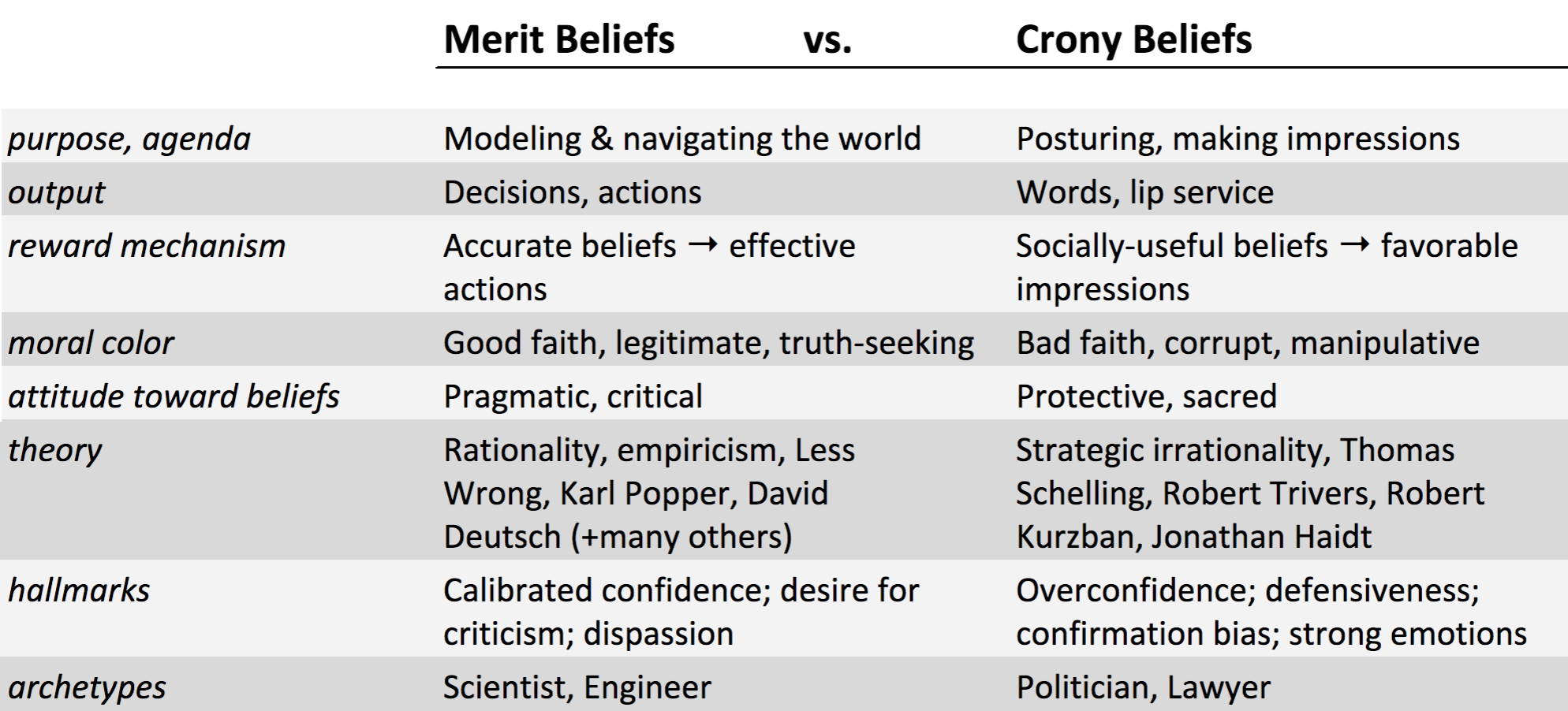
merit_vs_crony_beliefs

RESPONSIBLE USAGE

Before we go any further, a brief warning.
One of my main goals for writing this essay has been to introduce two new concepts — merit beliefs and crony beliefs — that I hope make it easier to talk and reason about epistemic problems. But unless we're careful, these concepts can do more harm than good.
First, it's important to remember that merit beliefs aren't necessarily true, nor are crony beliefs necessarily false. What distinguishes the two concepts is how we're rewarded for them: via effective actions or via social impressions. The best we can say is that merit beliefs are more likely to be true.
The other important subtlety is that a given belief can serve both pragmatic and social purposes at the same time — just like Robert could theoretically be a productive employee, even while he's the mayor's nephew. Suppose I were to believe that "My team is capable and competent," for example. This has pragmatic value, insofar as it contributes to my decision to stay on the team (vs. looking for a new one), but it also has social value, insofar as my team is more likely to trust me when I express this belief. So is it a "merit belief" or a "crony belief"? Mu. When labels break down, it's wise to taboo them in order to get back in touch with the underlying reality — which in our case, looks something like this:
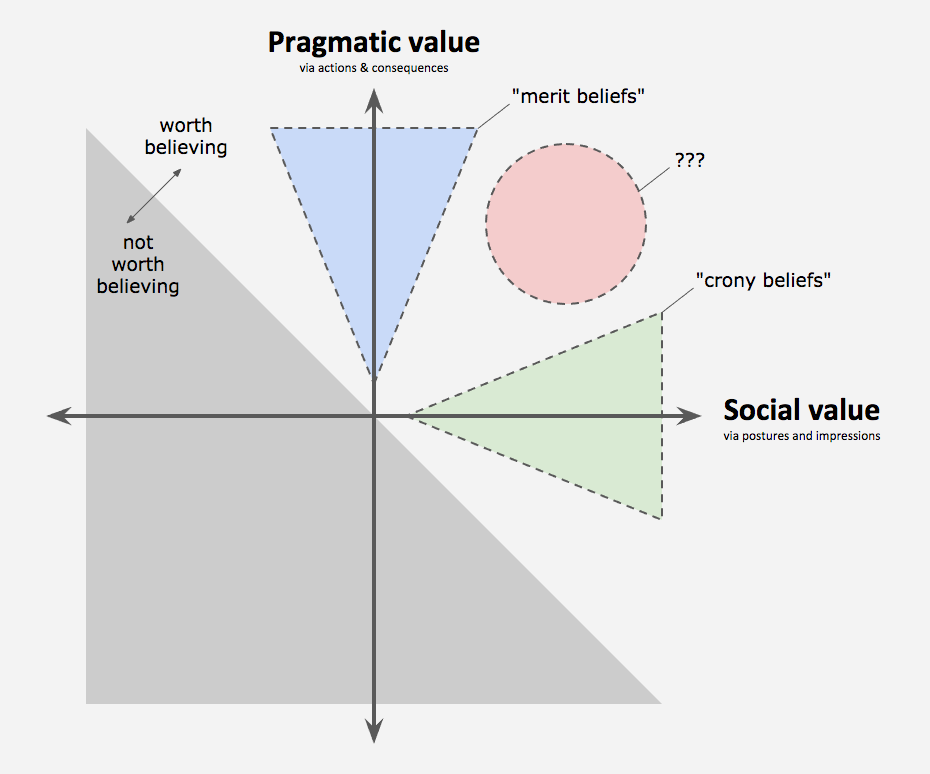
pragmatic_vs_social_value
When we call something a "merit belief," then, we're claiming that its pragmatic value far outstrips its social value. And if we call something a "crony belief," we're claiming the reverse. But it's important to remember that the underlying belief-space is two-dimensional, and that a given belief can fall at any point within that space.
With that in mind, I think it's safe to proceed.

IDENTIFYING CRONY BELIEFS

Now for the $64,000 question: How can we identify which of our beliefs are cronies?
What makes this task difficult is that crony beliefs are designed to mimic ordinary merit beliefs. That said, something in our brains has to be aware — dimly, at least — of which beliefs are cronies, or else we wouldn't be able to give them the coddling that they need to survive inside an otherwise meritocratic system. (If literally no one at Acme knew that Robert was a crony employee, he'd quickly be fired.) The trick, then, is to look for differences in how merit beliefs and crony beliefs are treated by the brain.
From first principles, we should expect ordinary beliefs to be treated with level-headed pragmatism. They have only one job to do — model the world — and when they do it poorly, we suffer. This naturally leads to such attitudes as a fear of being wrong and even an eagerness to be criticized and corrected. As Karl Popper and (more recently) David Deutsch have argued, knowledge can't exist without criticism. If we want to be right in the long run, we have to accept that we'll often be wrong in the short run, and be willing to do the needful thing, i.e., discard questionable beliefs. This may sound vaguely heroic or psychologically difficult, somehow, but it's not. A meritocracy experiences no anguish in letting go of a misbelief and adopting a better one, even its opposite. In fact, it's a pleasure. If I believe that my daughter's soccer game starts at 6pm, but my neighbor informs me that it's 5pm, I won't begrudge his correction — I'll be downright grateful.
Crony beliefs, on the other hand, get an entirely different treatment. Since we mostly don't care whether they're making accurate predictions, we have little need to seek out criticism for them. (Why would Acme bother monitoring Robert's performance if they never intend to fire him?) Going further, crony beliefs actually need to be protected from criticism. It's not that they're necessarily false, just that they're more likely to be false — but either way, they're unlikely to withstand serious criticism. Thus we should expect our brains to take an overall protective or defensive stance toward our crony beliefs.
Here, then, is a short list of features that crony beliefs will tend to have, relative to good-faith merit beliefs:
  • Abstract and impractical. Merit beliefs have value only insofar as we're able to make use of them for choosing actions; we need some "skin in the game." If a belief isn't actionable, or if the actions we might take based on the belief (e.g., voting) don't provide material benefits one way or the other, then it's more likely to be a crony.
  • Benefit of the doubt. When we have social incentives to believe something, we stack the deck in its favor. Or to use another metaphor, we put our thumbs on the scale as we weigh the evidence. Blind faith — religious, political, or otherwise — is simply "benefit of the doubt" taken to its logical extreme.
  • Conspicuousness. The whole point of a crony belief is to reap social and political rewards, but in order to get these rewards, we need to advertise the belief in question. So the greater our urge to talk about a belief, to wear it like a badge, the more likely it is to be a crony.
  • Overconfidence. Related to the above, crony beliefs will typically provide more social value the more confident we seem in them. (If Acme hires the mayor's nephew, but seems constantly on the verge of firing him, the mayor isn't going to be happy.) Overconfidence also acts as a form of protection for beliefs that can't survive on their own within the meritocracy.
  • Reluctance to bet. Betting on a belief is just as good as acting on it; both mechanisms create incentives for accuracy. If we're reluctant to bet on a belief, then, it's often because some parts of our psyche know that the belief is unlikely to be true. Hence the challenge: "Put up or shut up."
But perhaps the biggest hallmark of epistemic cronyism is exhibiting strong emotions, as when we feel proud of a belief, anguish over changing our minds, or anger at being challenged or criticized. These emotions have no business being within 1000ft of a meritocratic belief system — but of course they make perfect sense as part of a crony belief system, where cronies need special protection in order to survive the natural pressures of a meritocracy.

J'ACCUSE

Now for the uncomfortable part: wherein I accuse you, dear reader, of cronyism.
Specifically, I charge you with harboring a crony belief about climate change. I don't care whether you subscribe to the scientific consensus or whether you think it's all a hoax — or even whether you hold some nuanced position. Unless you're radically uncertain, your belief is a crony.
"But," I imagine you might object, "my belief is based on evidence and careful reasoning. I've read in-depth on climate science and confronted every criticism of my position. Hell, I've even changed my own mind on this topic! I used to believe X, but now I believe Y."
Here's the problem: I'm not accusing your belief of being false; I'm accusing it of being a crony. And no appeal to evidence or careful reasoning, or even felt sincerity, can rebut this accusation.
What makes for a crony belief is how we're rewarded for it. And the problem with beliefs about climate change is that we have no way to act on them — by which I mean there are no actions we can take whose payoffs (for us as individuals) depend on whether our beliefs are true or false. The rare exception would be someone living near the Florida coast, say, who moves inland to avoid predicted floods. (Does such a person even exist?) Or maybe the owner of a hedge fund or insurance company who places bets on the future evolution of the climate. But for the rest of us, our incentives come entirely from other people, from the way they judge us for what we believe and say. And thus our beliefs about climate change are little more than hot air (pun intended).
Of course there's nothing special about climate change. We find similar bad-faith incentives among many different types of beliefs:
  • Political beliefs, like whether gun control will save lives or which candidate will lead us to greater prosperity.
  • Religious beliefs, like whether God approves of birth control or whether Islam is a "religion of peace."
  • Ethical beliefs, like whether animals should have legal personhood or how to answer the various trolley problems.
  • Beliefs about the self, like "I'm a good person," or "I have free will."
  • Beliefs about identity groups, like whether men and women have statistically different aptitudes or whether certain races are mistreated by police.
Since it's all but impossible to act on these beliefs, there are no legitimate sources of reward. Meanwhile, we take plenty of social kickbacks for these beliefs, in the form of the (hopefully favorable) judgments others make when we profess them. In other words, they're all cronies.
So then: is it hopeless? Is "believing things" a lost cause in anything but the most quotidian of domains?
Certainly I've had my moments being wracked by such despair. But perhaps there's a sliver of hope.

BETTER INCENTIVES

Conventional wisdom holds that the way to more accurate beliefs is "critical thinking." Lock yourself in a room with the Less Wrong sequences (or the equivalent), study the principles of rationality and empiricism, learn about cognitive biases, etc. — and soon you'll be well on your way to a mind reasonably free of falsehoods.
The problem with this approach is that it addresses the symptom (irrationality) without addressing the root cause (social incentives).
Let's return to Acme for a moment. Imagine that some clueless (but well-meaning) executive notices that Robert and a handful of other workers aren't getting fired, despite their shoddy work. Not realizing that they're cronies, the exec naturally suspects the problem is not enough meritocracy. So he launches a campaign to beef up performance standards, replete with checklists, quarterly reviews, oversight committees, management training seminars, etc., etc., etc. — all of which is more likely to hurt the company than to help it. The two most likely effects are (1) the cronies get fired, and the city council comes down hard on Acme, or (2) the other execs, who are clued in to the cronyism, have to work even harder to protect the cronies from getting fired. In other words, Acme suffers more "corporate dissonance."
Now if our executive crusader understood the full picture, he might instead direct his efforts outside the company, at the political ecosystem that allows strong-arming and corruption to fester. If he could fix Nepotsville city politics, he'd be quashing the problem at its root, and Acme's meritocracy could then begin to heal naturally.
Back in the belief domain, it's similarly clueless (if well-meaning) to focus on beefing up the "meritocracy" within an individual mind. If you give someone the tools to purge their crony beliefs without fixing the ecosystem in which they're embedded, it's a prescription for trouble. They'll either (1) let go of their crony beliefs (and lose out socially), or (2) suffer more cognitive dissonance in an effort to protect the cronies from their now-sharper critical faculties.
The better — but much more difficult — solution is to attack epistemic cronyism at the root, i.e., in the way others judge us for our beliefs. If we could arrange for our peers to judge us solely for the accuracy of our beliefs, then we'd have no incentive to believe anything but the truth.
In other words, we do need to teach rationality and critical thinking skills — not just to ourselves, but to everyone at once. The trick is to see this as a multilateral rather than a unilateral solution.[6] If we raise epistemic standards within an entire population, then we'll all be cajoled into thinking more clearly — making better arguments, weighing evidence more evenhandedly, etc. — lest we be seen as stupid, careless, or biased.
The beauty of Less Wrong, then, is that it's not just a textbook: it's a community. A group of people who have agreed, either tacitly or explicitly, to judge each other for the accuracy of their beliefs — or at least for behaving in ways that correlate with accuracy. And so it's the norms of the community that incentivize us to think and communicate as rationally as we do.
All of which brings us to a strange and (at least to my mind) unsettling conclusion. Earlier I argued that other people are the cause of all our epistemic problems. Now I find myself arguing that they're also our best solution.

_____
Appendix
Yes, I've sunk to writing an appendix to a blog post. Click here to read it, especially if you're interested in these two questions: (1) What actual evidence do we have that our brains are engaging in cronyism? and (2) Why don't we simply lie (instead of internalizing crony beliefs)?