Tuesday, August 23, 2011

middle of the road tax policy
From the communist manifesto chapter 2. Note that these measures are UNTENABLE on purpose and designed to bring about the worker's revolution...Note that Marx and Engels think these measures are despotic. Now, we call it "middle of the road" and "compromise" we're so used to it. The text is quoted below, emphasis mine.
The proletariat will use its political supremacy to wrest, by degree, all capital from the bourgeoisie, to centralise all instruments of production in the hands of the State, i.e., of the proletariat organised as the ruling class; and to increase the total productive forces as rapidly as possible.
Of course, in the beginning, this cannot be effected except by means of despotic inroads on the rights of property, and on the conditions of bourgeois production; by means of measures, therefore, which appear economically insufficient and untenable, but which, in the course of the movement, outstrip themselves, necessitate further inroads upon the old social order, and are unavoidable as a means of entirely revolutionising the mode of production.
These measures will, of course, be different in different countries.
Nevertheless, in most advanced countries, the following will be pretty generally applicable.
1. Abolition of property in land and application of all rents of land to public purposes.
2. A heavy progressive or graduated income tax.
3. Abolition of all rights of inheritance.
4. Confiscation of the property of all emigrants and rebels.
5. Centralisation of credit in the hands of the state, by means of a national bank with State capital and an exclusive monopoly.
6. Centralisation of the means of communication and transport in the hands of the State.
7. Extension of factories and instruments of production owned by the State; the bringing into cultivation of waste-lands, and the improvement of the soil generally in accordance with a common plan.
8. Equal liability of all to work. Establishment of industrial armies, especially for agriculture.
9. Combination of agriculture with manufacturing industries; gradual abolition of all the distinction between town and country by a more equable distribution of the populace over the country.
10. Free education for all children in public schools. Abolition of children’s factory labour in its present form. Combination of education with industrial production, &c, &c.
Monday, August 22, 2011
Keynes vs the space aliens
This is kinda smart assed, but it's a quick overview on how the policy prescription of the 30s didn't work, how WWII did NOT bring us out of depression, and how a 68% cut in spending after the war not only DIDN'T crater the economy but gave us the most successful years ever in history...
Anyone who says that WWII got us out of the depression is wrong, first of all, but also, in doing so admit that none of the extraordinary measures of the great depression worked. So let's not try it again, everybody.
What worked? Cutting government down to 32% of what it was...
Tuesday, August 9, 2011
The Road to Serfdom
Inspired by The Illustrated Road to Serfdom
passing ghosts that shake their heads
We go driving down this road
toward the noise that's up ahead
toward the roaring of the serf
Mobilize
your freedom's at stake
your culture, your wi-fi
sacrifice for the state
The plan will bring peace
prosperity, high rise
rise up for utopia
rise up for the grand prize
which utopia wins
pet plans become lions
the people divide
and the quotient is violence
enforce the ideal
re-educate the resistance
a reluctant dictator
ensures he converts the masses
passing ghosts that shake their heads
We go driving down this road
toward the noise that's up ahead
toward the roaring of the serf
the plan fails and falls
the last measure is desperate
a strong man is raised up
force the doubters compliance
surf the popular wave
and rally round the leader
dissent now is too late
people disappear forever
life, job, economy planned,
heads down, because mistakes are crime
you're not just fired
you're sent to the firing line
passing giants that shake their heads
We go driving down this road
down the road to serfdom
towards the noise that's up ahead
towards the roaring of the serf
towards the silence of the serf
passing ghosts that shake their heads
We go driving down this road
toward the noise that's up ahead
toward the roaring of the serf
Mobilize
your freedom's at stake
your culture, your wi-fi
sacrifice for the state
The plan will bring peace
prosperity, high rise
rise up for utopia
rise up for the grand prize
which utopia wins
pet plans become lions
the people divide
and the quotient is violence
enforce the ideal
re-educate the resistance
a reluctant dictator
ensures he converts the masses
passing ghosts that shake their heads
We go driving down this road
toward the noise that's up ahead
toward the roaring of the serf
the plan fails and falls
the last measure is desperate
a strong man is raised up
force the doubters compliance
surf the popular wave
and rally round the leader
dissent now is too late
people disappear forever
life, job, economy planned,
heads down, because mistakes are crime
you're not just fired
you're sent to the firing line
passing giants that shake their heads
We go driving down this road
down the road to serfdom
towards the noise that's up ahead
towards the roaring of the serf
towards the silence of the serf
Monday, August 8, 2011
Basic economics part 7 - Ownership
After the last post some words on ownership is called for. Ownership is nothing more complicated then the ability to control something. If I get to choose what I do with a certain fish, then I own that fish. If I can not exercise control over the fish, I don't own it. If someone steals something, they have taken over ownership of the object without your permission.
So even in the relationship where everything is shared, Gilligan owned the fish up to the point where he voluntarily parted with it. As long as he does that voluntarily, then, again, it isn't against any of the "capitalism" I talked about before. He feels that he's better off exchanging his goods for being part of society.
But when he no longer wants to make that exchange, he should be able to keep his fish, and his shelter and berries. If he can't, then he doesn't own them. If he doesn't own them, then he doesn't own his own labor, or the time he took to catch the fish and berries either. If someone steals Gilligan's fish, then how is that any different than forcing him to catch a fish?
The root of the matter is that ownership is control over a certain piece of property.
This is basically the formulation of natural rights. Crusoe owns himself and can do with himself what he wants (as far as it doesn't interfere with other people's ownership of their bodies). Since Crusoe owns himself, he owns that which he finds in nature and transforms with his labor. If I build an axe and anyone can come and use that axe, then that means they have essentially used my body to build an axe for their purposes without my permission. If they use my body without my permission then I don't own it. So obviously I own the axe by extension of my self ownership. I can voluntarily trade that axe to you, and relinquish ownership over that part of my labor and then you own that axe, same as I can voluntarily trade my labor directly for goods you provide.
This is only an issue because of scarcity. If axes magically appeared when Crusoe thought about an axe, then it wouldn't matter if he took my axe. I would wish another one into existence and off I'd go. Air is very nearly a case of this. If I breathe air, it doesn't prevent Crusoe from getting as much air as he needs. So, there isn't really a market for air, though pollution does put a cost on clean air that we're familiar with.
This has a very interesting and "radical" impact on intellectual property. Ideas are not scarce. Pretend that Crusoe has an idea to make a net to catch fish, and he tells that idea to Gilligan. If Gilligan makes the net, has Crusoe suddenly lost the ability to use his idea? That is can Crusoe no longer make a net because Gilligan "stole" his idea?
So an idea is NOT property, because it is not scarce. It is like a candle where Gilligan can light his candle off of Crusoe's without Crusoe's flame going out. Did Gilligan steal Crusoe's flame? If Gilligan steals Crusoe's axe, Crusoe can no longer cut down trees, he no longer has use of the object so it's ownership was taken without permission. With an idea though, Crusoe still has use of his idea, even if Gilligan copies or "steals" it.
Some would object that Gilligan, in copying the idea has reduced the value of Crusoe's idea. Generally, this is because the inventor is given a monopoly privilege and since he has no competitors he can charge more. This is not necessarily true, for one, and no one can own value for two.
For the first objection, the music industry is a good example. Crusoe's Etude in D, which Crusoe recorded and put on a CD in his closet, has little value to anyone. No one has heard of it, or him. Along comes Gilligan, and hears the tune playing. He records it himself and puts that Etude into a popular TV show. Suddenly everyone wants copies of this Etude, and come to find out Crusoe wrote it. Now his CDs are selling like hot cakes. Stealing Crusoe's idea then, made Crusoe's idea MORE valuable. This is very often the case.
Of course value can not be owned, because value is subjective. Remember before when Gilligan and Crusoe traded fish and coconuts. Gilligan subjectively felt that Crusoe's fish was valued more than two coconuts. Gilligan therefore determines the "value" of Crusoe's fish. If Gilligan gets food poisoning and doesn't want to buy any fish next time the value of Crusoe's fish is nothing. Gilligan doesn't want to buy it, therefore the fish has no value. So has Crusoe been wronged because suddenly his fish has no value? Should he sue Gilligan for not buying his fish. If value has ownership, then every time fickle consumer demand shifts, and a toy manufacturer is left holding a container ship full of cabbage patch dolls, somebody would have to be sued or imprisoned. Anyone who decided not to buy a cabbage patch doll, I suppose, should be locked away for "stealing" the value of the dolls. Absurd!
That means, then, that there is no such thing as intellectual property from principle. It could be argued that we have it for practical reasons, but Boldrin and Levine (http://levine.sscnet.ucla.edu/general/intellectual/againstfinal.htm) have done a good job crushing that idea. If you believe you have proof that intellectual property is indeed a positive force, please send me a link to the paper.
Ownership is central to capitalism then, as if Crusoe doesn't control his property, then he can't save it or trade it. If he doesn't control his property than whoever does control it, has enslaved Crusoe, at least partially, for the time it took to acquire his property. Therefore property rights are paramount.
Fair or Flat tax versus Income tax
Note: click on the tables and they open up nice and clear, I'm sorry they are hard to read here.
A lot of conservatives want to see changes in the tax code, and point to things like the fair tax or the flat tax.
A flat tax is a constant percentage of income no matter how much you make. This would mean keeping the IRS and all of the complications of figuring out what is and is not "income" and reporting all of it. It is still progressive, as in the rich pay more than the poor. So basically, it does two things, simplifies the tax code a little bit, and makes sure that the poor pay their "fair share". Some people may see a benefit in charging more taxes to the poor and therefore less to the rich, to bring in the same amount of money to the government. I don't see it. I think that's pretty gross actually.
I've blogged this before, but the percentages that people actually pay in federal taxes, when all taxes are taken into account (personal income tax, wage taxes, excise taxes, corporate income taxes, etc) are as follows.
lowest Quintile = 5%
Second Quintile = 10%
Third Quintile = 15%
Forth Quintile = 17%
Fifth Quintile = 25%
So having everyone pay say, 20% would be a huge hit to the poor and middle class and the rich would benefit. Silly.
So how about this "fair tax". It is more interesting. They want to abolish all federal taxes and have everybody pay a sales tax. You can go to their site if you want to learn the details. Everybody gets to keep all of their salary, and the only thing that gets taxed is their consumption. In addition, everyone gets a free handout of $X,000 as a "prebate" to cover the taxes on "essentials". Ideally, then, even though all of your food is taxed, you get a prebate so that it is nominally untaxed.
How the government plans on picking that prebate is open for debate. Is it tied to inflation? Is it tied to marital status, number of children, etc? There is the same potential for social engineering here as there is for income tax. Technically the baby sitter and garage sales need to collect taxes as well, but we already ignore that income, even if we aren't supposed to, so I'll let that objection slide. I do wonder though if land or houses would be taxed?
Furthermore, it doesn't change anything. Rothbard points out that it doesn't matter if you tax current consumption (fair tax) or future consumption (income tax). What matters is the amount that the government taxes, and that won't change unless spending is addressed.
I can prove that with some spreadsheets, but inadvertently the spreadsheet uncovers some other problems.
Let's set the stage. I have three people in my little model society. One makes 10,000, one makes 100,000 and one makes 1,000,000. I assume they all save 10% of their after tax income, and I assume that they pay at the rates above: 5% for the lowest quintile and 17% and 25% for the upper two. After taxes, and savings everything else is consumed.

Now, I'll take the same three people and put them into a Fair tax. I kept the amount of money that the government took in and the amount of goods that each person bought constant. I picked a $2000 prebate, because it refunded about 2/3rds of the poor persons taxes and because it just made everyones savings rate positive. Let's see what happened.

First the sales tax rate was a whopping 36%. This makes sense the government before taxed all income, now it is only taxing the income that is spent, so it has to collect a higher percentage.
Also, notice, how the total income, total taxes collected and total savings in the world are the same. So a fair tax doesn't change the amount that people save averaged over the whole economy.
What is very scary though is looking at the individual savings. The poor person used to save $950, now he saves $366. So he's actually poorer now. He either saves less or is forced to consume less.
Our middle class person is in even WORSE shape. They used to save $8300 and now they are only saving $355! They got absolutely routed for $8000 a year. They have to cut WAY back or decide to stop saving for the future.
We saw before though that the total savings in the community is constant, so if the poor and middle class got cut, guess who made all the gains? The person making a million dollars did. Further more, since those savings won't be taxed, he can invest that money and put FURTHER distance between the rich and the middle class and poor.
In conclusion, given these numbers the fair tax wiped out the middle class and poor and made the rich richer.
Let's play with the spreadsheet a little bit, and try and give the middle class their savings back. In order to do so, you have to give everyone a prefund of more than $13,000 and jack up the tax rate to compensate to 40%! You can guess what this does. It now siphons money the other way. It takes $10,000 from the rich guy and gives it to the poor guy. This is highly redistributive, and who knows how it will change things. Will the guy making $10,000 a year bother working if he can collect $13,000 doing nothing? I don't know how to iterate this to the next level.

So in the end, all people are doing with these huge disruptive changes in the tax code are moving savings around from one person to another, or keeping savings the same, and ruining peoples standard of living. And what is gained? You don't have to pay taxes on what little you keep after paying the huge sales taxes. Depending on who you are you might come ahead or you might get wiped out. I can't figure out yet if there is a net benefit to society from all this. It gives more incentive to save, sure, but it makes it harder to do so unless you are making a million dollars a year. Or it takes large savings from rich people and distributes it into smaller savings for lots of people, who will probably get fleeced in the stock market trying to keep inflation at bay.
More likely everyone will just adjust their spending habits until about the same amount is saved, corrected for the now increased cost of goods, and better return on investment since it isn't taxed. So where do we end up? Back at the beginning except that money is redistributed differently.
Cutting spending is the only fix for taxes. I'm sorry.
For fun, I edited the numbers using the actual quintile percentages from the CBO site (link) and the average salary for each of those quintiles to scale the problem correctly.
The final tax rate was 32% with a $3000 prefund...EVERY quintile gets wiped out except the richest...hmm...

Thursday, August 4, 2011
another light on the debt "crisis"
Ron Paul on how the big hullabaloo was business as usual. The math and the vocabulary was seriously misleading.
Wednesday, August 3, 2011
Basic economics part 6 - voluntary vs force
The nature of the charity is also unimportant in the last post (basics part 5). Gilligan and Crusoe could decide just to put all their fish and berries into a pool. They could elect Gilligan to distribute the pool. Most people would recognize this arrangement as distinctly not capitalism as it is to each according to his need, etc. Strangely, I find that it is completely consistent with capitalism. When it is done voluntarily, it isn't at odds with anything that I've written so far.
This is an interesting twist. Communism and socialism can actually be free market capitalism, as long as the arrangement is voluntary. It doesn't matter if the arrangement is not efficient, not practical or whether or not there is a problem of calculation. What characterizes the free market is freedom and voluntary action. Communism and socialism are just ways of exchanging your property for inclusion in a particular group. A person may value that group more than all of his belonging, just as he may value 1 fish more than 20 berries.
To be a voluntary arrangement though, a person has to be free to exit the arrangement, for whatever reason, even if it is "wrong". In order to exit the arrangement, then the fish and berries that Gilligan collects have to stay with Gilligan and not go to the collective any more. Only things that he's given to the collective, do the executors of the collective own. If the group forces you to give up your berries and fish, then that is no longer voluntary, and no longer free market. The property already given can not be taken back, but no one can control what you own. More on that in the next section on ownership.
It is immediately obvious then that where the free market is characterized by voluntary actions, all other arrangements therefore are characterized by force, or the threat of force.
State action is always force. If Gilligan gets a speeding ticket and he doesn't want to pay it, do they come rifle through his pockets? No. But what if he doesn't pay it? He gets a warrant, and if he doesn't pay the warrant? Then he goes to jail. If someone asked Gilligan nicely to go to jail, though as punishment for not paying a speeding ticket would he go? Heck no. He knows that if he doesn't go, though, they'll force him to go, and make it worse for him on top of it all. They will literally drag him to jail, his feet making two lines in the soil. Ultimately if he resists this initiation of force against him, he will be killed. So even speeding tickets are backed up by the threat of forceful kidnapping and even death. All State action is backed up by the threat of force.
Some may claim that the speeder initiated force by breaking the law. This is ridiculous. If your neighbor tells you to do something and you don't want to do it, have you initiated force against them? Of course not.
It is worth it here, I think, to discuss a tired old cliche. No one forces anyone to live here. If you don't like it, leave. Implicit in this is that by choosing to stay here, I choose to subject myself to the rules of the governing body, no matter what they are. Again, this is patently ridiculous. Let's say there is a vote, and if it passes then everyone who lives in an green house will be killed and their belongings distributed. Green houses, being in the minority are outvoted and killed. This is ok, because they implicitly agreed to live by the rules and the rules dictated their execution?
From another angle, subjugation to the local authority necessarily means that I do not own my land, and that it belongs to the State. I will explain. Recall the voluntary arrangement above, where Gilligan gives his fish to the collective. If he voluntarily chooses not to participate in the collective then he retains his fish and berries. If Gilligan owns land, then the collective obviously cannot come on his land anymore than they can take his fish. If they can, then it is not a voluntary collective. So logically, participation in the State is not voluntary, since we can not renounce our participation in the collective and stay there, or the other conclusion we could draw is that we never owned the land to begin with. If my land belongs to the State, they can rightly do what they want with it, and I have no ethical recourse. If I don't own my land do I own anything that I make with my land? Generally speaking, no. If I wander into someone's driveway and paint their car, do I own their car now? No. So if I plant seeds in the State's soil, do I own the tomatoes that spring forth? No.
Therefore, the logical result of the phrase, "if you don't like it, leave" is that the State owns everything. The idea of a free market and a State that is defined by geographical boundaries then are fundamentally at odds with each other. It does not rule out a voluntary collective, a voluntary government, and perhaps multiple voluntary governments in the same area. This really isn't as big of a deal as it sounds. Take county roads for example. Neighboring counties somehow manage to make their roads line up with each other without a governing authority. They manage to upkeep those roads without taxing people from other counties, and no one really bothers much about it. Also, look at religion. There are several competing religions with competing rules and they don't bother each other in this country, where there is freedom of religion. One neighbor may be Jewish, one Christian, one Pagan, and they somehow reconcile their disputes with outside parties even with vastly different religious views of justice. You can read more here.
The free market, and capitalism is identified by voluntary action. All else is force and violence. Even voluntary socialism is free market, even if it is ill advised in practical terms. By extension of this logic, it is seen that all States are illegitimate under the principles of freedom. It is just as illogical to call for limited government as it is call for complete totalitarian control if property rights are indeed, rights. The next article therefore will explore the legitimacy of the idea of property and ownership.
who will think of the poor
With the debt ceiling debate stirring up the partisan pot of wasps, you get a lot of articles and post by people like this.
cute. Let's look at this.
55% of the budget goes to SS, medicare, safety net programs, etc. So 3.5 trillion * 0.55 = 1.9 trillion. let's say we just give that to the lowest 50% of income earners, that's everybody making under about $50,000. That's 60 million families.
It adds up to $32,000 per family per year. hmmmm....seems that I could buy my own healthcare and all the food I wanted at $32,000 a year. I could even save up for college. I could easily retire if I had a guaranteed $32,000 a year.
So, you gotta ask yourself, are our government programs really helping the poor? Certainly not as much as they are costing us.
Of course that number nearly doubles if you include all our spending...Now, the democrats, republicans and progressives are telling me that in all that spending, $60,000 a year for 50% of all americans...they can't find 40% spending cuts and still help the poor?
Like deities in all religions, the Lord of the Market is trying to tell its followers to be kinder to the elderly, the sick, and the poor.
cute. Let's look at this.
55% of the budget goes to SS, medicare, safety net programs, etc. So 3.5 trillion * 0.55 = 1.9 trillion. let's say we just give that to the lowest 50% of income earners, that's everybody making under about $50,000. That's 60 million families.
It adds up to $32,000 per family per year. hmmmm....seems that I could buy my own healthcare and all the food I wanted at $32,000 a year. I could even save up for college. I could easily retire if I had a guaranteed $32,000 a year.
So, you gotta ask yourself, are our government programs really helping the poor? Certainly not as much as they are costing us.
Of course that number nearly doubles if you include all our spending...Now, the democrats, republicans and progressives are telling me that in all that spending, $60,000 a year for 50% of all americans...they can't find 40% spending cuts and still help the poor?
Monday, August 1, 2011
ACTUAL tax distribution
Governments CBO numbers
You hear a lot of talk about how the rich don't pay their fair share. This seemed odd to me because it was incongruous with the idea that 50% pay no taxes at all. What is going on here? If you believe the rhetoric then NO ONE is paying taxes. That's certainly not true.
So the governments numbers from 2007.
ie...this is accounting for everything.

Higher-income groups earn a disproportionate share of pretax income and pay a disproportionate share of federal taxes. In 2007, the highest quintile earned 55.9 percent of pretax income and paid 68.9 percent of federal taxes.

You hear a lot of talk about how the rich don't pay their fair share. This seemed odd to me because it was incongruous with the idea that 50% pay no taxes at all. What is going on here? If you believe the rhetoric then NO ONE is paying taxes. That's certainly not true.
So the governments numbers from 2007.
This page contains CBO's estimates of average federal tax rates (tax rates as a percentage of income) paid by households in various income categories for the four largest sources of federal revenues--individual income taxes, social insurance (payroll) taxes, corporate income taxes, and excise taxes--as well as the average rate for the four taxes combined. The page also contains estimates of average before- and after-tax household income; the number of households in each income category; shares of taxes, income, and households for each income group; information relating to the methodology used to construct the estimates; supplementary estimates for different types of households; and estimates of the number of households that pay more in payroll taxes than they do in income taxes.
ie...this is accounting for everything.

Higher-income groups earn a disproportionate share of pretax income and pay a disproportionate share of federal taxes. In 2007, the highest quintile earned 55.9 percent of pretax income and paid 68.9 percent of federal taxes.

Garbage in. Garbage out
New satellite data shows that the base assumption used in models that predicted dire global warming........was wrong.
Gosh, it is hard to believe that extra carbon dioxide DOESN'T create a negative feedback loop that leads to the death of all life on earth. We really dodged a bullet a hundred million years ago when CO2 was 1700 ppm (4 times what it is now). All of those giant dinosaurs were just eeking out an existence in a horrible, HORRIBLE lush green paradise...I shudder to think what a return to such biodiversity would mean....shudder...

Cartoon credit to XKCD
Gosh, it is hard to believe that extra carbon dioxide DOESN'T create a negative feedback loop that leads to the death of all life on earth. We really dodged a bullet a hundred million years ago when CO2 was 1700 ppm (4 times what it is now). All of those giant dinosaurs were just eeking out an existence in a horrible, HORRIBLE lush green paradise...I shudder to think what a return to such biodiversity would mean....shudder...
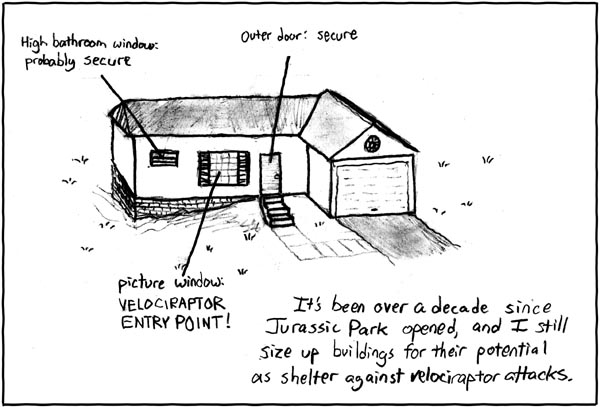
Cartoon credit to XKCD
Subscribe to:
Posts (Atom)